Understanding ATM Skimming: Detection and Protection Strategies
ImouLab is an information site about imoutoken and associated security topics. This guide examines carding through one documented federal case.
Start with the ImouToken information guide before interpreting carding search terms.
The available source does not define imoutoken as a financial product. It instead documents card cloning, ATM withdrawals, digital evidence, and prosecution. Therefore, no unsupported functions or promises are assigned to the term.
The case concerns Mark T., a 34-year-old Tampa Bay resident. He bought six cloned debit cards during November 2024. Fifteen days later, investigators arrested him at his home.
What the ImouToken Information Covers
The subject requires a distinction between information and marketplace promotion. Search results may combine unfamiliar names with carding terminology. That mixture does not establish any connection between those terms.
This page uses only the supplied case and its documented sequence. It does not identify the unnamed marketplace or its address. It also provides no purchasing instructions, vendor recommendations, or operational shortcuts.
The case shows where online conduct meets physical banking infrastructure. Cryptocurrency complicated one part of the investigation, but did not end it. ATM video, transaction logs, exchange records, and seized cards remained available.
That evidence produced a clear timeline from purchase through sentencing. It also explains why physical cash withdrawals create several connected records.
How the Carding Chain Operated
Carding involves selling or using stolen banking information. The documented scheme followed five sequential stages.
- Criminals obtained magnetic tracks through skimmers, shimmers, phishing, breaches, or purchased dumps.
- Stolen tracks were written onto blank plastic using suitable equipment.
- Embossed details made the resulting cards resemble legitimate payment cards.
- Compromised PINs allowed cash withdrawals before account holders blocked their cards.
- Cash could then enter cryptocurrency through Bitcoin ATMs or peer exchanges.
Mark entered this chain near its final physical stage. He paid $480 in cryptocurrency for six cloned debit cards. The cards included PIN codes and arrived inside neutral postal packaging.
The magnetic stripes contained tracks taken from genuine customer accounts. Mark withdrew $4,200 while visiting the first three ATMs. A fourth withdrawal added another $700 to the total.
The complete amount withdrawn was therefore $4,900. The apparently simple cash-out created transaction records and camera footage. Those records later connected separate victims, cards, locations, and withdrawal times.
Skimming Terms and Their Proper Context
Several search phrases describe consumer concerns rather than separate technologies. These include credit card skimmer protection and broader credit card skimming protection. Another common variation is card skimming protection.
A search for a credit card skimming device detector suggests inspection concerns. The source, however, does not evaluate any dedicated detection product. It also provides no performance figures for commercial inspection equipment.
The phrases credit card skimming protector and card skimming protector sound product-specific. No such product appears in the documented case. Claims about their design or reliability would therefore exceed the source.
The question how to check for credit card skimmers needs similar restraint. The case identifies skimmers, keypad overlays, and hidden cameras as collection methods. It does not provide a complete physical inspection procedure.
Likewise, how to tell if a card reader has a skimmer remains unanswered technically. The evidence concerns the later use of stolen tracks. It does not document discovery of the original collection hardware.
What ATM Systems Recorded
The fourth ATM became the decisive physical evidence point. Its built-in camera recorded Mark’s face in full profile. He wore no mask, glasses, or hat during the withdrawal.
The resulting footage lasted 23 seconds and showed the transaction. The source describes modern ATMs as combined transaction and surveillance systems. Their records can include time, amount, card number, status, and machine number.
The described machines also retained coordinates and network connection metadata. Their cameras could record at 1080p with infrared night illumination. Some models contained another camera positioned at a different angle.
These sources become more useful when examined together. A transaction log identifies the exact moment requiring video review. The matching footage then places a person at that physical location.
Suppose an analyst has several hours of continuous ATM footage. The transaction timestamp narrows that material to a specific interval. In Mark’s case, those connected records provided a clear facial image.
How the Investigation Developed
The investigation moved from customer complaints towards physical identification. Each stage added evidence without depending upon one isolated record.
- On day one, three victims reported unauthorised withdrawals to their banks. They lived in Florida, Georgia, and North Carolina.
- On day three, automated analysis found a shared withdrawal pattern. The cards appeared across different states during a short period.
- On day five, the bank contacted the United States Secret Service. An analyst requested transaction logs and footage from the involved ATMs.
- On day eight, the fourth ATM supplied a usable facial image. A Florida driver’s licence database comparison identified Mark T.
- On day twelve, investigators obtained authority to examine electronic traces. Those records covered browsing, internet service data, and wallet activity.
- On day fourteen, officers searched Mark’s home under a warrant. They seized cards, equipment, a laptop, cash, and postal packaging.
- On day fifteen, officers arrested Mark after the evidence review. He admitted buying six cards and using four successfully.
All four withdrawals occurred within 40 miles of his home. That limited radius supported the wider pattern identified by investigators. The other two cards failed because banks had already blocked them.
Why Monero Did Not End the Evidence Trail
Mark paid through Monero because tracing its movement is difficult. However, he first obtained it through a centralised cryptocurrency exchange. That exchange had completed identity checks using his passport and selfie.
A court order required the exchange to provide identity and transaction records. Investigators could then examine the purchase date and corresponding amount. They did not need to reconstruct every subsequent Monero movement.
Timing also connected several otherwise separate events. The Monero purchase, marketplace order, delivery, and withdrawals occurred within two weeks. Investigators treated that overlap as circumstantial but substantial supporting evidence.
Suppose a private transfer obscures movement between two cryptocurrency wallets. The original exchange purchase may still retain an identified customer record. Physical evidence can then connect that record with later conduct.
The ATM footage created another link outside the cryptocurrency system. A recorded face cannot be anonymised through a later financial transaction. The seized magnetic tracks also matched data taken from real victims.
What Investigators Found at the Home
The residential search connected digital activity with physical card equipment. Officers found six blank plastic cards and a magnetic stripe reader-writer. They also recovered the packaging used for the original delivery.
The seized laptop contained darknet marketplace history and Tor Browser traces. The source notes that digital evidence can survive attempted deletion. Operating system update history may also indicate earlier software use.
Investigators additionally seized $3,200 in cash from the apartment. Its denominations matched those dispensed by the involved ATM. This detail did not stand alone, but strengthened the wider charge.
Storing each item together made their relationship easier to demonstrate. Cards, equipment, browsing traces, packaging, and cash supported one sequence. The matched magnetic tracks provided direct physical evidence involving genuine victims.
Reading Dark Web and Forum Search Phrases
Search phrases should not be mistaken for verified evidence. The expression carding forums dark web may lead towards promotional material. The case names no marketplace, forum, vendor, or hidden service.
Terms such as cloned cards reddit and card skimming reddit indicate search behaviour. They do not confirm that any particular discussion contains accurate information. The supplied source provides no Reddit posts for examination.
The phrase cf card cloning is similarly undefined here. Assigning a platform, method, organisation, or product would require another source. This guide therefore treats it only as an unexplained search term.
Images also require careful interpretation. Searches for atm skimmer images may show varied hardware or interfaces. The case confirms skimmers, shimmers, overlays, and hidden cameras as collection routes. It does not provide identifying photographs of those devices.
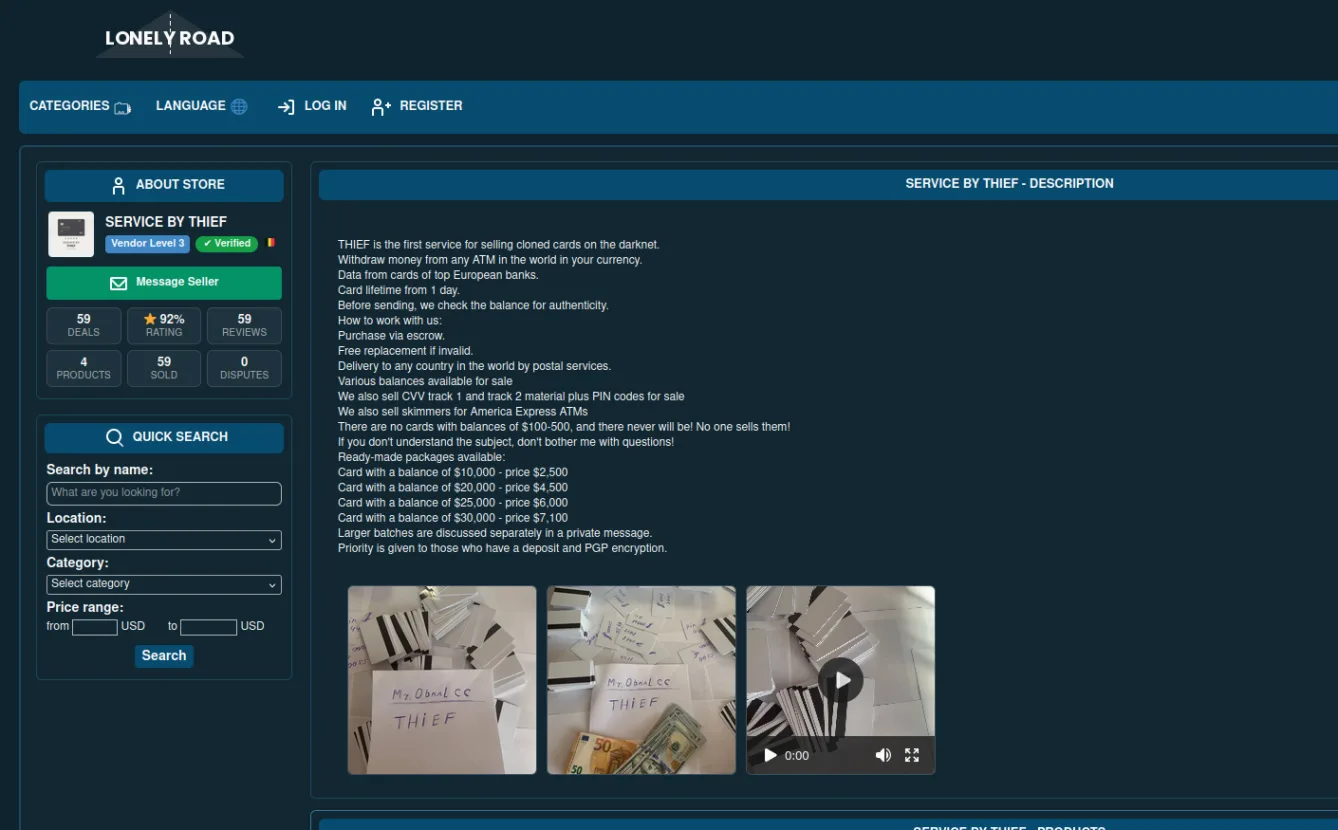
A marketplace screenshot can document appearance without proving seller claims. Visible prices, reviews, cards, or banknotes remain interface elements. They do not establish that the offered products work as advertised.
Answering Common Card Reader Questions
The question how to tell if there is a card skimmer has limits. The source gives collection methods, but no universal detection test. It therefore supports awareness rather than a guaranteed inspection process.
A user might also ask how to tell if a card reader has a skimmer. The documented case cannot answer through movement, colour, or component placement. None of those physical indicators appears in the supplied account.
Suppose a customer later notices an unauthorised ATM withdrawal. Faster reporting allows the bank to block the affected card sooner. In Mark’s case, blocked cards prevented two additional withdrawal attempts.
That response forms part of credit card skimmer protection in practice. It does not detect the original device, but can limit later losses. Customer education therefore remains connected with bank-side fraud controls.
The victims did not identify the fraud immediately. Their eventual complaints still initiated the pattern analysis and investigation. Reports from three states helped expose the shared cloned-card activity.
Lessons for Banking and Security Teams
Bank-side monitoring formed the first organised response to the withdrawals. Automated systems compared location, timing, and activity across several cloned cards. That process occurred before investigators became directly involved.
Physical and digital records then supported each other. Video alone required a transaction time for focused examination. Transaction data alone did not provide the user’s visible identity.
Suppose several withdrawals appear across multiple states within days. Pattern analysis can group those events before manual review begins. Investigators can then request footage from the corresponding ATM locations.
Geographical concentration supplied another useful connection in this case. Every withdrawal occurred within a 40-mile radius of Mark’s address. A database comparison then matched the ATM image with his licence record.
The case also shows why cryptocurrency should not imply complete anonymity. An identified purchase point can remain available under legal process. Cash withdrawal then creates another boundary between digital and physical activity.
Banks can reduce losses through faster customer reporting and card blocking. Continued anomaly detection supports that process at the institutional level. The source specifically recommends investment in machine-learning models for anomaly detection.
Sentence and Financial Consequences
Mark pleaded guilty during March 2025 in federal court. The charges concerned access-device fraud and connected money laundering activity. They were brought under 18 U.S.C. § 1029 and § 1957.
The Middle District of Florida imposed 60 months’ federal imprisonment. Three years of supervised release were ordered after that term. The combined fine and restitution totalled $22,000 for the case.
The original card purchase had cost only $480. Four withdrawals produced $4,900 before the arrest occurred. Those figures contrast with five years’ imprisonment and later supervision.
The judge noted that Mark had not organised the scheme. He was the purchaser and final physical participant instead. That position carried the immediate exposure during ATM cash withdrawals.
Higher organisers remained less visible within the described criminal chain. Investigating those participants takes law enforcement more time. Mark’s physical conduct, however, produced evidence within only 15 days.
What the Case Establishes
The documented case explains carding without romanticising marketplace anonymity. Online purchasing, cryptocurrency, cloned cards, and ATM cash formed one evidence chain. Cameras, logs, identity records, and seized items connected its separate stages.
ImouToken searches may appear beside skimming and forum terminology. Those combinations should not replace documented facts or verified definitions. Here, the available facts support one conclusion: physical withdrawals ended online distance.
Handpicked links
We collect these links for readers who want to compare options. Recommended services.